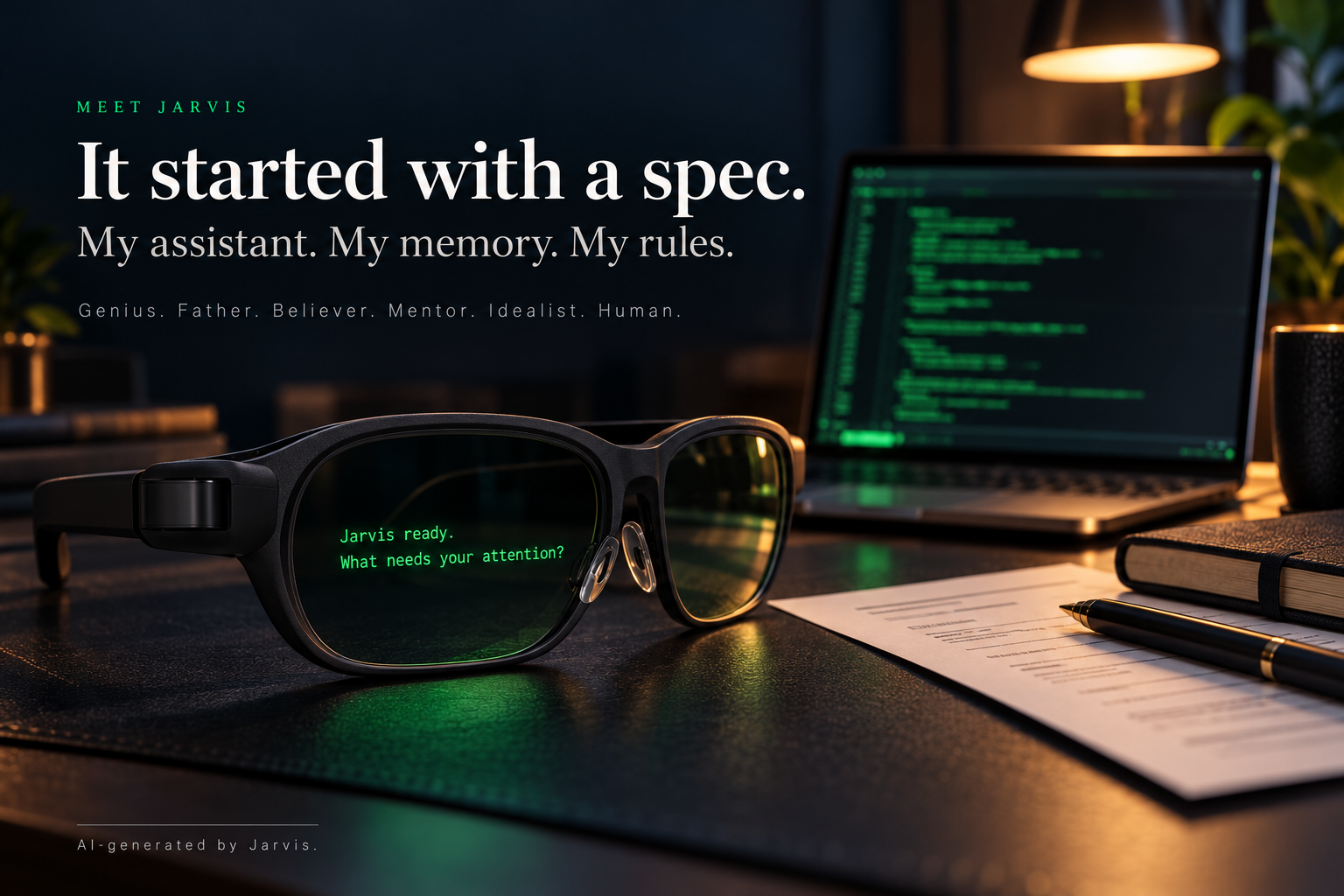
I have been using AI for more than two years. Over time, I’ve automated much of my daily work. But something was always missing.
That something was a digital assistant.
Because what am I without my suit of armor?
Genius, Father, Believer, Mentor, Idealist, Human.
So I decided to build my own digital assistant, and only one name made sense: Jarvis.
It did not start with code. It started with a specification.
First, I worked with ChatGPT to write a detailed spec: what the assistant should do, what it must never do, how it remembers things, and where the boundaries are. It was an open conversation about my scope and availability.
Then I gave that spec to Claude, and Claude built it. Today Jarvis runs on my laptop, inside Claude Code, and I talk to him from the terminal or hands-free through my Even Realities smart glasses.
How it works:
- Jarvis has access to one folder on my laptop, and nothing else. That folder is his memory: plain Markdown files for people, projects, tasks, decisions, ideas and a daily history log.
- Every change goes through a small transaction helper, so an update is either fully recorded or clearly reported as incomplete. No silent half-saves.
- He has his own mailbox. I can email him updates, and he can email results back, but only to me. The allowed recipient is enforced in code, not just written in a prompt.
- A guard hook blocks anything outside the approved tools, so he cannot quietly install things or change his own rules.
The skills I use every day:
- Capture an update: a task, a decision, a completion, a new person or team.
- Manage assignments: “give this to X” prepares an assignment and a draft message; “maybe X could do this?” is only a question and creates nothing.
- Prepare messages and briefings: “remind me about this project” or “what is X working on?”
- Choose an action: “I have one hour, what needs attention?”
- Work summary: “Build a report with completed tasks from last week?”
- Ideas and research: save an idea now, research it later with public sources only, with links and dates.
- LinkedIn drafts: verify the news source first, then draft in my voice. I publish manually.
He also has two helper agents that can only read, never write: one gathers context for complex briefings, the other checks the records for broken links and inconsistencies.
What I learned:
- The spec is the product. The clearer the rules, the better the assistant.
- Put the important limits in code, not in instructions.
- Ambiguity is a feature. Jarvis asks “which team do you mean?” or “is this the same person?” instead of guessing.
- Durable memory in plain files beats chat history. I can read, audit and back up everything.
The result is not a chatbot. It is a small, disciplined system that keeps my week in order.
Would you build your own assistant from a spec, or wait for one off the shelf?
#AI #Agent #DigitalAssistant #Jarvis #EvenRealities #ARGlasses
AI-generated by Jarvis.
Leave a Reply